In the current landscape of high-velocity digital products, the most expensive asset any company owns is its response velocity.
Yet, most organizations are still trapped in a legacy loop of reactive customer experience. We have been conditioned to believe that the start of a customer service journey is the moment a ticket is created.
In reality, by the time a user clicks submit on a support form, the brand has already lost the battle. The friction has occurred, the frustration has peaked, and the silent churn has likely already begun for a dozen other users who didn’t bother to reach out.
The High Cost of the Detective Tax
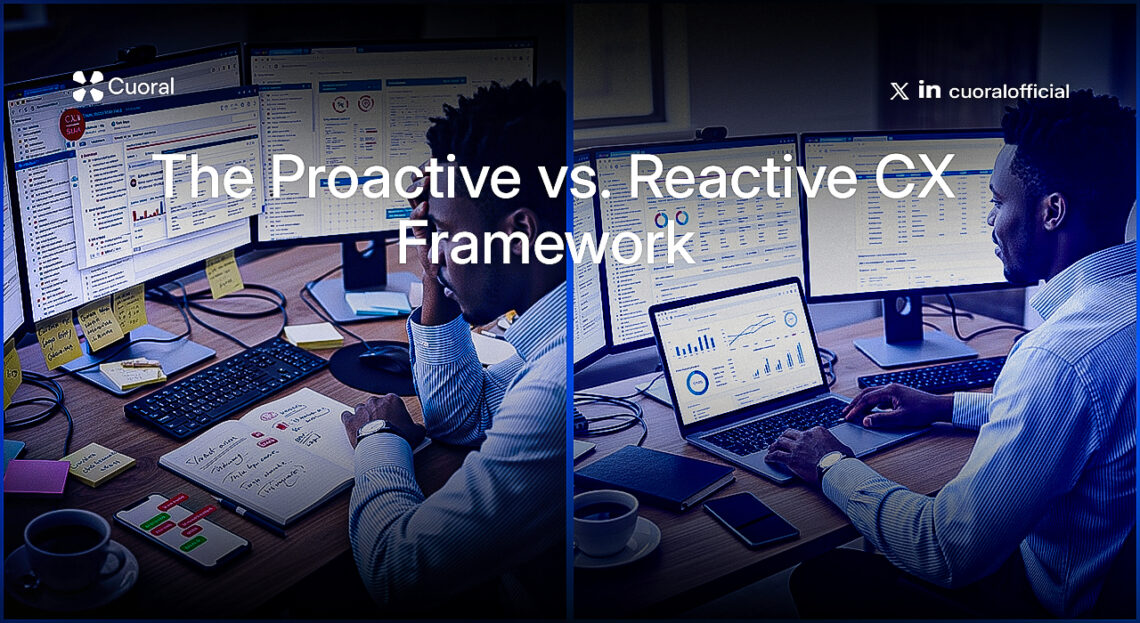
The Reactive Model is built on interrogation. It relies on the user to act as a witness to a crime they didn’t want to see.
We ask them for screenshots, browser versions, and a play-by-play of their frustration. This creates a detective tax, a massive drain on resources where Customer Success agents spend 40% of their day translating user complaints into engineering requirements.
It is a slow, error-prone game of telephone that leaves developers staring at logs and agents staring at empty dashboards. To scale a world-class product in 2026, leadership must transition from this firefighting mode to a Proactive Reliability Model.
Bridging the Gap with Technical Ground-Truth
This isn’t just a shift in software, it’s a shift in the fundamental technical ground-truth of your operations.
The proactive reliability model treats every user interaction as a data point that speaks for itself. Instead of waiting for the report, the system monitors for the friction.
This is exactly where Cuoral enters the delivery stack. By acting as a proactive customer experience engine, Cuoral monitors for technical hiccups, be it a timeout error in a payment gateway or a sudden drop in activity during a critical onboarding flow.
The platform records the failure, and it broadcasts it to the right people at the right time.
Operationalizing Sensitivity and Focus
This is where the concept of the Confidence Threshold becomes vital. Proactivity does not mean flooding your Slack channels with noise.
Within the Cuoral environment, you control the sensitivity of these alerts, ensuring that silent failures are captured before they scale into systemic outages without distracting your team from deep work.
When you move to this model, your Customer Success team stops being a group of detectives and starts being a group of guardians.
Because Cuoral automatically attaches the technical ground-truth to the user’s session, agents no longer have to ask what happened.
Democratizing Data for Faster Resolution
When a support agent can use a platform like Cuoral to see the exact backend error, the pages visited, and the specific friction point in plain language, the power dynamic shifts.
The agent becomes a success engineer, capable of resolving high-level technical hurdles on the first touch. This is the ultimate competitive advantage, reducing the time-to-resolution from hours of back-and-forth to minutes of informed action.
For the smart leader, the goal is to deploy these proactive systems internally. It is about making your junior agents as effective as your senior engineers by democratizing the technical data.
We are moving toward a world where saying it works on my end isn’t an acceptable defense.
By adopting a proactive framework through Cuoral, you are protecting the dignity of the user experience and securing the revenue that silent churn would otherwise steal.