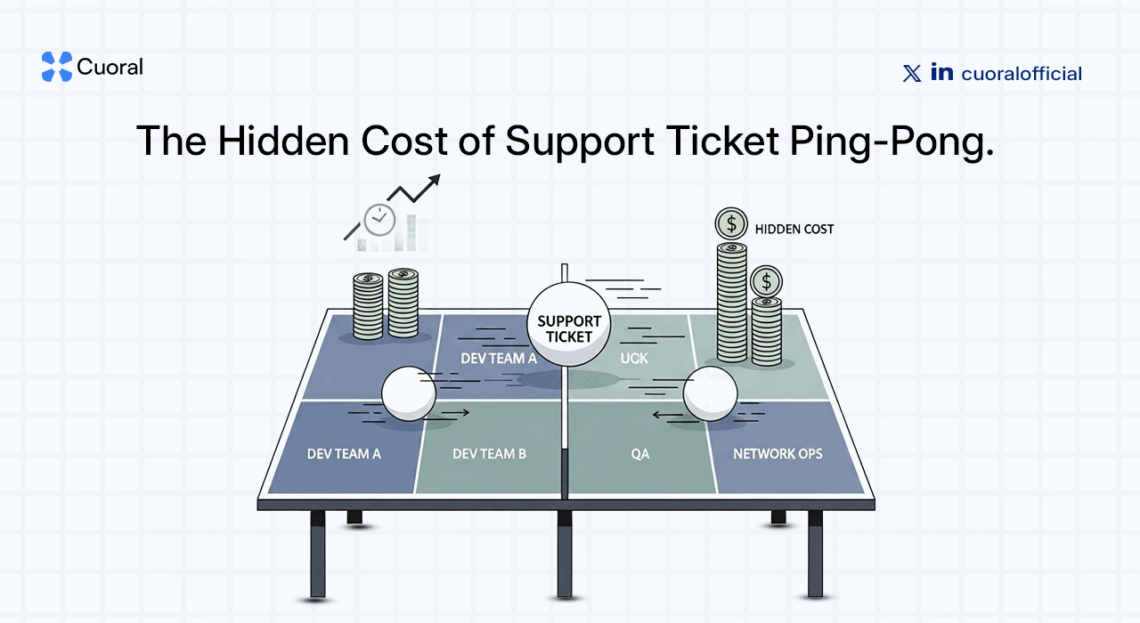
Support ticket ping-pong is one of the most expensive problems most digital platforms don’t measure properly.
It happens when a customer reports an issue, support investigates, engineering asks for more context, the ticket goes back to support, and the cycle repeats. Nothing is resolved quickly, ownership becomes blurred, and the customer is left waiting. On the surface, this looks like normal internal collaboration. In reality, it is silent operational leakage.
Every bounce costs time. Every handoff costs focus. And every delay erodes trust.
The real problem is not that support teams are slow or that engineers are uncooperative. The real issue is visibility. Support sees symptoms. Engineering sees logs. The actual user experience sits in the middle, undocumented and unseen. When no one has a shared, session-level view of what happened, the ticket becomes a guessing game.
This is where internal resources quietly drain away.
Support teams spend hours asking follow-up questions. Engineering teams try to reproduce issues they cannot see. Product teams struggle to tell whether a problem is user error, a device limitation, or a real defect. Meanwhile, the customer keeps refreshing their inbox, wondering if anyone is actually working on their case.
The financial cost shows up in longer resolution times, increased support workload, and higher churn. The trust cost is even worse. When customers feel bounced around internally, they stop believing in the platform’s reliability. In high-stakes environments like payments, logistics, healthcare, or commerce, that loss of confidence is often permanent.
The fastest way to stop ticket ping-pong is not more meetings or stricter SLAs. It is shared ground truth.
When support and engineering can see the same session data, conversations change immediately. Instead of debating what might have happened, teams can see exactly where a user’s screen stalled, which network handoff failed, or whether the device froze during a critical step. Tickets move forward instead of sideways.
This is where Cuoral fits into the workflow.
Cuoral gives teams visibility into the real user session behind every ticket. Instead of treating tickets as abstract reports, teams can see the technical reality of what the user experienced at the moment of friction. That context removes guesswork and shortens resolution cycles.
Cuoral’s widget also plays a critical role earlier in the process. Users can create tickets directly from the interface and track their progress without leaving the product. This reduces duplicate complaints and follow-up messages while giving customers confidence that their issue is being handled. For internal teams, it means fewer fragmented conversations and clearer ownership from the start.
Most importantly, tickets created this way arrive with context already attached. Support does not need to reconstruct the story. Engineering does not need to chase screenshots. Everyone starts from the same source of truth.
Support ticket ping-pong is not just an efficiency problem. It is a visibility problem. Platforms that solve it do not just resolve issues faster. They protect trust, reduce internal strain, and scale without burning out the people doing the work.
When teams stop bouncing tickets and start seeing clearly, support becomes a strength instead of a cost center.
And that is where reliability truly begins.