In the race to build the perfect mobile app, many teams chase a specific holy grail, the screen recording. The logic seems sound cos if a user is struggling, we should record their screen to see what happened.
But as we move further into 2026, this request is increasingly being recognized for what it is, a privacy nightmare and a technical dead end. In fact, most sophisticated companies avoid video recording entirely because it crosses a line that users (and OS providers) simply won’t tolerate.
At Cuoral, we call this the Mobile Visibility Paradox. To get the visibility you need to fix your app, you shouldn’t have to compromise the very things that make your app successful: privacy, performance, and user trust.
The Privacy Red Line
The reason you rarely see successful apps using full-screen video recording is simple, Privacy Compliance. Modern mobile operating systems (Android 14+ and iOS 18+) have correctly prioritized user safety. To record a screen today, you must trigger a system-level popup that asks the user for permission. Not just once, but often every single time a session starts.
This creates a trust tax. If a user is already having a bad experience, a sudden system popup asking to Share Screen is the final nudge they need to delete your app. Furthermore, video recording, when done poorly captures sensitive system notifications, private messages, and personal data that have nothing to do with your app’s performance.
Beyond Pixels: UI Reconstruction
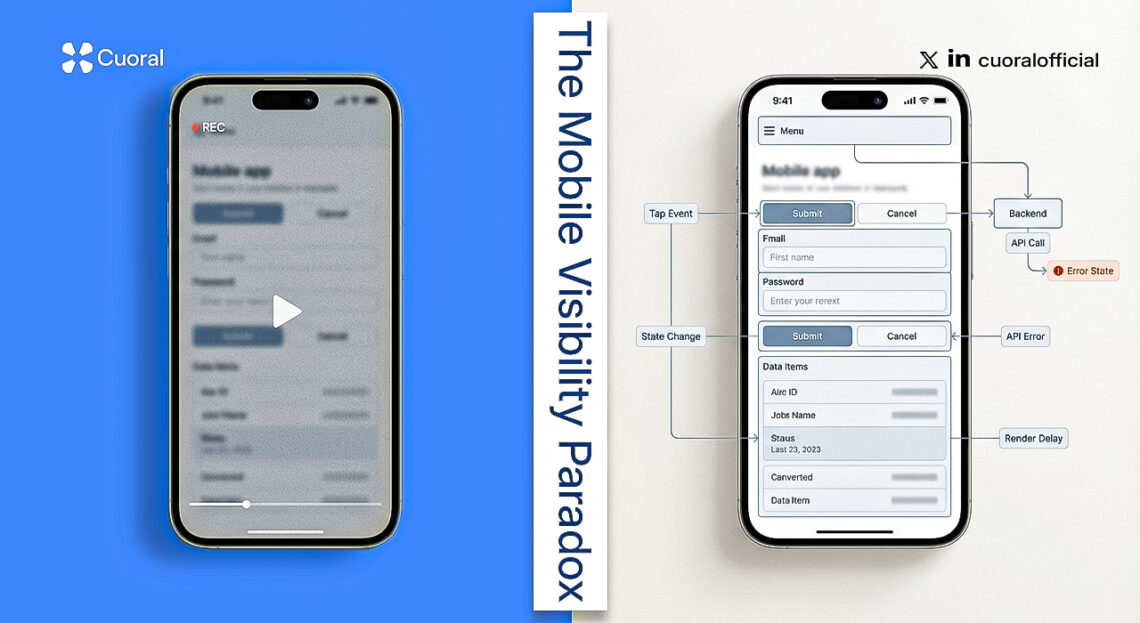
The future isn’t video, it’s Event-Based Reconstruction.
Instead of recording heavy pixels, the next generation of observability focuses on UI Metadata. By capturing the native components and interaction events like taps, scrolls, pauses, and specific element IDs, we can reconstruct the user journey with total accuracy while user-generated screen recordings can add layered context.
This approach uses less than 1% of the data of a video. More importantly, it requires zero intrusive permissions. You see the technical ground truth, the exact button that failed or the logic that stalled, without ever invading the user’s private system space.
The Proactive Pivot
The ultimate goal of visibility isn’t just to watch what happened in the past. It’s to change the future.
When you move away from heavy video, you gain the ability to be proactive. If a user is stuck on a KYC flow for more than two minutes, a lightweight system can alert your team instantly. You don’t need to watch a movie later to find out they left, you can see the silent struggle as it happens and intervene in real-time.
The Bottom Line
If your strategy still relies on only capturing screen recordings, you are fighting against the grain of modern security and user expectations.
True product integrity comes from seeing the technical events that matter without capturing the pixels that don’t.
It’s time to stop trying to record screens without permission and start understanding journeys.